http://www.youtube.com/watch?v=l_vVmeUf6QU
It's here. Yet again.
Never felt so helpless in my life ever before.
We all can overcome personal problems: a bad marriage, divroce, a bad job, a bad relationship, bad finances - anything. But when it comes to the falling rupee against the dollar or women getting raped, kids being molested, there's nothing we can do, except to feel outraged, tired, disturbed, and ultimately, helpless. For crimes against humanity, we look at the people who control the law and order or the economics of the nation. And it is not a pretty picture.
Every problem has a root. The problem of gang rape - especially 16 Dec 2012 and 22 August 2013 -
are deep rooted in our social and mental ethos. It's hard even to blame. Boys from affluent families don't do such things. Yet boys from downtrodden families go on to achieve a great many things. Not all Muslims are bad people. Not all women want attention. Not all cops take bribe. It's so hard to generalize. So where must we begin to understand the problem? It is important because we must solve it.
Family is the basic unit, or so we were taught in Sociology. The values a person imbibes - or fails to - determines his character in the long run. And no matter how uncomfortable our families make us feel, we always return to our nest to trace our first emotions and reactions.
So what goes wrong with our mentality? Didn't the mothers of rapists teach their sons to respect women? I find it hard to understand that a sexually deprived man would go out and rape a lone woman.
Man cannot fall to such levels. But he has. Is sex so important that he is willing to beat the genitals of the opposite sex, that would take a woman's life? Is anything worth that? What exactly goes wrong in the minds of these criminals?
We hear of suicide bombers taking the lives of innocent people. This justification of mass killing can be found in the hands of a calculated, misled belief and conveniently misconstrued doctrines of religion, economics and politics. What about rape, crimes against women and molestation of new born babies? What justification can lie beneath this lust? And to what end?
Why cannot a woman go out and watch a movie with a friend/ lover/ colleague at 7PM in the Capital? Why cannot a woman go and wander, explore for aesthetics at 6PM in the country's financial capital and the most developed city? We all know the lengths photo-journalists go to capture a stunning scene that holds our breaths on magazine covers. Why cannot a woman take a lone bike ride on a highway, see the sky complete its journey from dusk to dawn?
There were answers to these questions. A woman must always look after her shoulder, must not wander alone at odd hours or step out in the night, or apply make-up, or wear anything that would make a man want to lust after her. So will wearing a burqa rid our society of all the crimes? What about molestation of kids aged 6? What kind of make-up do they apply? Or what kind of soliciting clothes do 5 month old babies wear that makes men want to violate them?
Or a woman is only allowed to live - and not met by female infanticide - for the sake of amusing men, for procreation, for doing laundry, cooking. She cannot go and watch movies, she cannot be a daring photojournalist, a traveler. She is here to meet the demands made by man. She is a mother, sister, a wife. That's all. Is she not a human being, a person in her own right?
A man can walk safely at night, alone. At the most, he might be mugged, or murdered. But he won't be violated or left to die because of his biological anatomy.
And though we didn't ask our maker for this anatomy, we will have to always look over our shoulder when we walk the streets of this country.
Friday, August 23, 2013


Monday, February 25, 2013
"When the stars go blue"
However impossible it may seem to know that there are somethings that are still sacred, and the heart's always scared of spoiling things, people and their spirits.
Lately, the pursuit of love - so synonymous with happiness - has become that. A fearful path. It is a fearful one because there's always a question.. a possibility what would happen if things went bad and what all things would be at stake when the destruction (that seems alarmingly possible) happen. It will become a catalyst to destroy a spirit - a yearning to do better and be better in life, because that is what the ultimate purpose is: to rise. Just, simply, rise.
We have often heard as much that life is a journey where we are supposed to make mistakes - and learn from them and try never to repeat them. If falling in love is a mistake, how does one avoid it? Why is this path the most difficult to walk?
The thing is, we can make mistakes in finding love... not look in the right places- but how in the world are we to know which place is right? They say the heart will guide us, but what happens when you start living so much in fear that you overpower your heart. Translate opportunities into threats. Risks, that will destroy other people's lives, emotions, perspectives, spirit if you were wrong.
That is a huge responsibility. I think it's a part of one's integrity, then, to be hated, or worse, to be misunderstood. You're just doing the world a favor.
Lately, the pursuit of love - so synonymous with happiness - has become that. A fearful path. It is a fearful one because there's always a question.. a possibility what would happen if things went bad and what all things would be at stake when the destruction (that seems alarmingly possible) happen. It will become a catalyst to destroy a spirit - a yearning to do better and be better in life, because that is what the ultimate purpose is: to rise. Just, simply, rise.
We have often heard as much that life is a journey where we are supposed to make mistakes - and learn from them and try never to repeat them. If falling in love is a mistake, how does one avoid it? Why is this path the most difficult to walk?
The thing is, we can make mistakes in finding love... not look in the right places- but how in the world are we to know which place is right? They say the heart will guide us, but what happens when you start living so much in fear that you overpower your heart. Translate opportunities into threats. Risks, that will destroy other people's lives, emotions, perspectives, spirit if you were wrong.
That is a huge responsibility. I think it's a part of one's integrity, then, to be hated, or worse, to be misunderstood. You're just doing the world a favor.
Wednesday, February 20, 2013
Lincoln - Movie Review
I've always been scared of watching Steven Spielberg's movies. They are unnaturally and unnecessarily long; I seem to agree with Alfred Hitchcock's view: the duration of a film must be directly proportional to the bowel holding capacity of men. But then, there was Daniel Day Lewis too, and I hadn't seen him since 'My Left Foot'. That's what prompted me to watch this film in the first place.
Now, here's a personal confession - I loved Daniel Day Lewis since I first saw him in 'My Left Foot', and I don't know till day how he really looks. It's just hard to imagine him anything beside the character or role he plays. And that must be the true hallmark of an artist: he has no face. And that's where I find affirmation to my personal motto: handsome is what handsome does. Looks really have nothing to do with it. I don't even want to find out how he looks, there's just no inclination.

Now, about the movie. This film is an extensive summary of the political and social atmosphere in 1865 in America for the abolishing slavery. The best description of the plot, the movie and what really happened then is provided by the party head for Radical Republic front in the Republican Party, by Thaddeus Stevens, -
Tommy Lee Jones did great justice to the role of Thaddeus Stevens, complimenting Daniel Day Lewis beautifully on screen. His dialogue delivery was the best, bringing laughter in an otherwise "serious, war drama". His earnest retorts were sometimes more interesting than the quotes and short stories by Lincoln himself. Joseph Gordon-Lewitt once again made me feel he's over-rated, as Lincoln's first born.
Apart from the history lesson, there's so much to be learnt here. The very things that we take for granted so easily, without a thought, was actually thought of worth fighting for - and dying for - back then. One speaker took the floor and remarked opposing President Lincoln's 13th amendment to abolish slavery, " [...] He's asking us to free these Negroes today... tomorrow he'll ask us to give them voting rights... what's next? Voting rights for women???!"
That moment everyone in the House of Representatives stood up unanimously against the illogical, "unnatural" thought on the mention of voting rights for women. Can we imagine what kind of a world it would have been had Lincoln's 13th amendment would have never seen the light of the day? No, we cannot fathom such a travesty. Because we are far too used to freedom and the idea of being equal. Many women still pass their right to vote as if it was nothing. But it is certainly a perspective to see men dying for a principle... and hundred thousand corpses being laid down for yet another principle of justice.

Abraham Lincoln was corrupt too, but that corruption was for a purpose - something higher to aspire for; and I can't help but contextualizing the man and his principles in the times that we live in today. If we thought our political system is bad, well take a look at that social and political environment - where they made history out of a challenge so immense and so important. If you thought your own life was hell, take a look at the conflict and curse of being a man, husband, father and a President.
Am just glad to have my idea of a true man converging with the man and the man who played his character.
This film shows us how important history is, and why honesty is such a virtue even today, when there's none to be had or given.
And then there were people who snored, and the ones who left the theater after 10 mins. Or so.
Now, here's a personal confession - I loved Daniel Day Lewis since I first saw him in 'My Left Foot', and I don't know till day how he really looks. It's just hard to imagine him anything beside the character or role he plays. And that must be the true hallmark of an artist: he has no face. And that's where I find affirmation to my personal motto: handsome is what handsome does. Looks really have nothing to do with it. I don't even want to find out how he looks, there's just no inclination.

Now, about the movie. This film is an extensive summary of the political and social atmosphere in 1865 in America for the abolishing slavery. The best description of the plot, the movie and what really happened then is provided by the party head for Radical Republic front in the Republican Party, by Thaddeus Stevens, -
The greatest measure of the Nineteenth Century. Passed by corruption, aided and abetted by the purest man in America.The movie flows at an appropriate speed, with a few witty sequences, enough to keep you engaged and entertained. The screenplay was also intense, the make-up and characterization was perfect. I am confident for Daniel Day Lewis' Best Actor Oscar; but the film doesn't deserve as Best Director or a Best Film nomination. Surprisingly, there were some hitches in direction and production values. I wonder if the Academy didn't notice or skipped it... 'Cloud Atlas' was a better choice for both Best Direction and Best Film categories. But am used to it now: every year one such masterpiece gets the famous Oscar snub (Remember INCEPTION?)
Tommy Lee Jones did great justice to the role of Thaddeus Stevens, complimenting Daniel Day Lewis beautifully on screen. His dialogue delivery was the best, bringing laughter in an otherwise "serious, war drama". His earnest retorts were sometimes more interesting than the quotes and short stories by Lincoln himself. Joseph Gordon-Lewitt once again made me feel he's over-rated, as Lincoln's first born.
Apart from the history lesson, there's so much to be learnt here. The very things that we take for granted so easily, without a thought, was actually thought of worth fighting for - and dying for - back then. One speaker took the floor and remarked opposing President Lincoln's 13th amendment to abolish slavery, " [...] He's asking us to free these Negroes today... tomorrow he'll ask us to give them voting rights... what's next? Voting rights for women???!"
That moment everyone in the House of Representatives stood up unanimously against the illogical, "unnatural" thought on the mention of voting rights for women. Can we imagine what kind of a world it would have been had Lincoln's 13th amendment would have never seen the light of the day? No, we cannot fathom such a travesty. Because we are far too used to freedom and the idea of being equal. Many women still pass their right to vote as if it was nothing. But it is certainly a perspective to see men dying for a principle... and hundred thousand corpses being laid down for yet another principle of justice.

Abraham Lincoln was corrupt too, but that corruption was for a purpose - something higher to aspire for; and I can't help but contextualizing the man and his principles in the times that we live in today. If we thought our political system is bad, well take a look at that social and political environment - where they made history out of a challenge so immense and so important. If you thought your own life was hell, take a look at the conflict and curse of being a man, husband, father and a President.
The job of a compass is to point to true North. That's all it does. Now, it doesn't tell you about the rocks, cliffs, and swamps that you might encounter while pursuing that direction. And if you, let's say, get stuck in the swamp, what is the point of knowing true North??"
Am just glad to have my idea of a true man converging with the man and the man who played his character.
This film shows us how important history is, and why honesty is such a virtue even today, when there's none to be had or given.
And then there were people who snored, and the ones who left the theater after 10 mins. Or so.
Sunday, December 23, 2012
Government scared of People: A rare sight
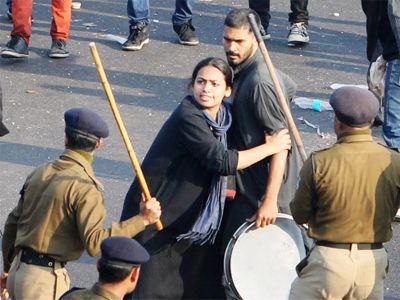
This is an important time for India and her people - both men and women.
This is not just standing up for women's right where rape only angers the female species. Even a man will be a father and a husband to someone - so will he wait for the "rarest of the rare" rape category to happen before he is assured that the rapist will be awarded a death sentence?
So as the country assembles at one of its most prestigious monuments, the India Gate, New Delhi, the government, media and the police gets a feel of the very people it hopes to subdue with the "system". Surprisingly, the media is supporting the cops - "They (the cops) had to fire cannons, because the public was pelting stones at them." Will someone ask why the people had to pelt in the first place?
Rahul Gandhi says that emotions cannot drive decisions. What is that even supposed to mean? Wait a minute, I know what he means. He means that we must all go home and sit and watch Dabang 2 and wait for the government to draft some anti-rape laws... like punishing rapists on "rarest of the rare cases".
The court is sentencing 14 days' jail to the rapists until identification and confession, under strict protection because the government is afraid if the people get hold of these rapists then they will kill the latter. It is interesting to note that for once, in our country the government and police are afraid of the people. Also interesting is the paradox: the police are now protecting rapists against the people.
Amid all this, people are asking the quintessential question: whether mob should drive political laws? Whether or not this is a case of democracy going in to the anarchy mode? I have a question for these people: Imagine what that rape victim must have gone through that she is still in the ICU even after a week, and cannot walk. The doctor today said she needed more stitches. Is this a picture of democracy?
The government should understand that people are, by definition, driven by apathy and indifference. When that basic shred of dignity is threatened, there will be violence, unrest and these protests. I am not justifying this. But then this has happened and we must analyze as to why people are driven to this point. Hopefully, we should find our answers there. All they care is about their right to life and luxury. The government cannot take this for granted. They cannot take forever to draft laws that must be for the protection of women's safety - it could be your mother or my sister.
I think India must have gone to protest the very day when the first public rape had come to light. If not for the anger of we, the people, this case would again be sidelined - by the media and the government who by default, loves to procrastinate. And we Indians, know that better.
Friday, December 21, 2012
Delhi Rape Case: "She Deserved it" ?
Ours is a nation where a rape occurs every 22 minutes. And only 25% of the reported rapists get convicted.

As usual, there is a huge public outcry about the Delhi rape case. MP Jaya Bachchan speaking out loud about the case, and about the victim, ".. while the media and press will forget this incident in weeks, months, the girl is scarred for life." MP Ram Jethmalani said, "If you want the Capital (of India) to be crime-free, then first take out the biggest criminal out of the Capital: Police Commissioner Neeraj Kumar."
This case has opened up a Pandora's box: from the way a woman dresses, to whether or not she should go out with male friends to watch movies at 8PM, to the police system in India that actually promotes crime, to the way men treat women as sex objects to the loose legal fabric in India concerning rape and molestation to Bollywood women gyrating to sleazy songs that actually encourage men to see women as nothing but objects of sex.
This Reuters blog post caught my attention. Why is there a huge outcry about the cultural values of Indian woman? What kind of a country can have the moral right to even question this? The kind of country that makes a heroine out of porn stars (Sunny Leone)? The kind of people who will make super-stars out of people like Katrina Kaif that have zero acting capabilities but huge tits? The kind of people who flock to the theatres to watch movies just because of item songs? Will these people determine how a woman should dress-up and whether or not she must watch movies with a male friend or not? Or will they decide if she should have a boyfriend? Will they decide when to punish her for her "indulgence"?
Not all women are fueled by insecurity to dress less and show more skin to attract more movies, more money and more fame, or even more guys. A woman could dress up to feel beautiful. Is this the way to appreciate a woman's physical beauty? If the entire society has no problem with pre-marital sex, who stands up and says that the girl should not have stepped out to watch movies with a male friend or acquaintance? Why the pretense?
Then there's the curious case of the involvement of police officers in their areas. A police officer, is by default, the image of power to common people like us. In Delhi, this is the "system": Walk in to a police station, place 50 grands on the table and tell the cop that you're going to murder someone. There won't be a FIR against you.
And let's say you the aggrieved party, you'll discover that most cops across Maharashtra (the most law and orderly state in the country) do not know how to draft a FIR. Cops in Mumbai do not know the difference between a FIR and NCR (Non-Cognizable Report). This is based out of my own personal experience from cops and courts and all things dirty.
It seems that Ram Jethmalani indeed has a point. Delhi Chief Minister Sheila Dixit and Police Commissioner Neeraj Kumar are to be blamed. Over the past couple of days, some people in my interaction have come to believe that the Indian society needs to adopt the Deterrent Type of Punishment: In the areas where a rape has occurred, publicly shoot the head inspector. The next person who occupies that office, will be scared. As far as the men (lack of a better word) who rape and think they can get away with it, are concerned, they must be publicly castrated or shot. At India Gate.
I have personally never been able to reason to myself if I support death penalty, or if I would endorse a gory punishment - even to those who deserve it. Perhaps it is the stupid romantic in me. There are some who said that they would want to set themselves on fire right in front of the President of India's residence - just to convey the thought that a life of a basic integrity in this country is so impossible.
Who are the real culprits? We are. We take it lying down.
"Where you live should not decide/ Whether you live/ or Whether you Die...
Three to a Bed/ Sister Ann she says/ Dignity Passes By...."
- U2
As usual, there is a huge public outcry about the Delhi rape case. MP Jaya Bachchan speaking out loud about the case, and about the victim, ".. while the media and press will forget this incident in weeks, months, the girl is scarred for life." MP Ram Jethmalani said, "If you want the Capital (of India) to be crime-free, then first take out the biggest criminal out of the Capital: Police Commissioner Neeraj Kumar."
This case has opened up a Pandora's box: from the way a woman dresses, to whether or not she should go out with male friends to watch movies at 8PM, to the police system in India that actually promotes crime, to the way men treat women as sex objects to the loose legal fabric in India concerning rape and molestation to Bollywood women gyrating to sleazy songs that actually encourage men to see women as nothing but objects of sex.
This Reuters blog post caught my attention. Why is there a huge outcry about the cultural values of Indian woman? What kind of a country can have the moral right to even question this? The kind of country that makes a heroine out of porn stars (Sunny Leone)? The kind of people who will make super-stars out of people like Katrina Kaif that have zero acting capabilities but huge tits? The kind of people who flock to the theatres to watch movies just because of item songs? Will these people determine how a woman should dress-up and whether or not she must watch movies with a male friend or not? Or will they decide if she should have a boyfriend? Will they decide when to punish her for her "indulgence"?
Not all women are fueled by insecurity to dress less and show more skin to attract more movies, more money and more fame, or even more guys. A woman could dress up to feel beautiful. Is this the way to appreciate a woman's physical beauty? If the entire society has no problem with pre-marital sex, who stands up and says that the girl should not have stepped out to watch movies with a male friend or acquaintance? Why the pretense?
Then there's the curious case of the involvement of police officers in their areas. A police officer, is by default, the image of power to common people like us. In Delhi, this is the "system": Walk in to a police station, place 50 grands on the table and tell the cop that you're going to murder someone. There won't be a FIR against you.
And let's say you the aggrieved party, you'll discover that most cops across Maharashtra (the most law and orderly state in the country) do not know how to draft a FIR. Cops in Mumbai do not know the difference between a FIR and NCR (Non-Cognizable Report). This is based out of my own personal experience from cops and courts and all things dirty.
It seems that Ram Jethmalani indeed has a point. Delhi Chief Minister Sheila Dixit and Police Commissioner Neeraj Kumar are to be blamed. Over the past couple of days, some people in my interaction have come to believe that the Indian society needs to adopt the Deterrent Type of Punishment: In the areas where a rape has occurred, publicly shoot the head inspector. The next person who occupies that office, will be scared. As far as the men (lack of a better word) who rape and think they can get away with it, are concerned, they must be publicly castrated or shot. At India Gate.
I have personally never been able to reason to myself if I support death penalty, or if I would endorse a gory punishment - even to those who deserve it. Perhaps it is the stupid romantic in me. There are some who said that they would want to set themselves on fire right in front of the President of India's residence - just to convey the thought that a life of a basic integrity in this country is so impossible.
Who are the real culprits? We are. We take it lying down.
"Where you live should not decide/ Whether you live/ or Whether you Die...
Three to a Bed/ Sister Ann she says/ Dignity Passes By...."
- U2
Sunday, November 25, 2012
Women's Rights, Human Rights: A Joke?
This is the true story of a girl from a town in Rewari, Haryana, fighting for her right to life in Mumbai.

Dolly Dabla turned turned 18 years old this August. She was three years old when her mother died due to a prolonged fever. The reasons for her death still remain uncertain to this very day. Shortly after, Dolly's father remarried.
Her step-mother was not comfortable, it seems, to have a three-year-old Dolly stay with her father and his new family. The step-mother had three kids from a previous marriage, who were accepted by Dolly's father. But Dolly was not allowed a mother or a real family. So it was decided that she stay with relatives from her paternal side, namely, her paternal grandmother, aunt (elder sister of her father), and uncles- Chachaji and Tauji. Her paternal grand mother expired soon.
Dolly's maternal aunts and grand parents asked her father to hand over the child's custody to them, assuring him that they will take good care of her. But her paternal aunt and father refused.
Domestic Violence & Abuse
As Dolly grew up, she was subjected to verbal abuse on a daily basis. Her younger paternal uncle (Chachaji) even beat her up occasionally She was made to do all household work from a very young age. She used to cook food for everybody in the family: from preparing vegetables to chapatis. The family didn't have a proper gas system, so she made food on a chulha. Her aunt's son, who is in his early 20's is often picked up the local cops for suspected role in thievery and burglary.
Irregular School Fees
Dolly's father paid a certain amount to her paternal aunt (Buaji) and uncle (Tauji) as school fees. Most of the time they didn't submit the fees. There were arrears of her school fees and her Principal said that the admission would be cancelled due to that. Dolly mentioned this to her father, and he then started submitting school fees directly to the school. This angered her Tauji and he sued Dolly's father, his own brother, for not giving money. So the father started giving money back to the family for her school fees in order to avoid litigation. The family now became a little more careful, and started paying school fees on time, more or less.
For her Board Exam fees, her school friend's father paid around INR10,000/- for Dolly's fees or she would not have been allowed a seat in 10th Standard.
Lack of Support for Education
Dolly chose Commerce stream for her 11th and 12th Standard. She needed some additional support in the form of coaching classes or tuition for Accounts. Her Buaji and Tauji refused that. Since she did all the household work, from cooking to washing utensils and cleaning, she hardly had enough time or energy to concentrate on her studies. Nobody took her education seriously. It was only a mere formality to them since they were paid "school fees" by her father.
Her Daily Routine
She woke up early morning to attend school and began her day by making morning tea for everyone in the house. She was then permitted to get ready for school. She was not given breakfast or lunch by her aunt. When she requested her aunt to at least give her a glass of milk in the morning, the latter replied, "Go and ask your father to pay first." ("Jaake Apne baap se bol ki paise de.")
So the girl went empty stomach to school. Sometimes, when she had the money for lunch during school recess, she'd eat in the school canteen. Most of the times, she'd be too depressed to eat and would often skip lunch.
She would come back home after school and was made to prepare lunch for everyone. Tired and hungry, she did as told. Then after lunch, she'd clean the house - the usual dusting, sweeping and mobbing. As the evening dawned, she'd make dinner for everyone in the night. Sometimes, when she finished preparing dinner early, she'd watch TV. But Buaji would switch off the TV and scold her for completing the work too soon.
Daily Humiliation & Insults
Dolly's identity in the house was that of a maid. She was repeatedly humiliated in front of everyone in the neighbourhood for all the work that she did. In fact, in metropolitan cities like Delhi and Mumbai, people treat maids with respect, for the fear that they might never turn up again. But this was not the case with Dolly. She was treated much worse than a maid servant, for, the family knew there was no place and no one she could go to.
This year, on her eighteenth birthday, her Tauji told her, "It would have been better if I had petted a dog, instead of raising you." ("Tujh se acha toh mai kisi kutte ko paal leta") Dolly's father was sitting right next to him and he didn't say a word.
Negligence of Health
Earlier this year, her menstrual cycle continued for three months. There was constant bleeding and she felt very weak due to this continued loss of blood from the body. Her Buaji did not take her to the doctor; she instead called a witch-doctor (as she had done when Dolly's mother had taken ill after child-birth). That did nothing to improve her condition (nor her mother's, leading to her death). She suffered from excruciating pain and loss of blood. Even in that condition she was made to do all household work. Her face became pale-yellow due to loss of blood and no nutrition.
Complete Forced Isolation- No contact with maternal relatives or friends
She was not allowed to talk to anyone in the neighbourhood or even have female friends.
Her maternal aunt (Maasi) wanted to keep her with her for a few days during her school vacations, but Dolly's Buaji refused. She was only allowed to meet her maternal uncle (Mamaji) for 1-2 days in Delhi. Those days were relieving for her and often, she didn't feel like returning to her Buaji's place. Her Mamaji and his wife used to pamper her and care for her. They also noticed her torn clothes and shoes in which she'd come to visit them. They often asked Dolly if she was alright, and she would not say a word.
Then, consequently, these meetings stopped. For the past 1-2 years, she was denied meeting even her Mamaji. Buaji took away her phone and forbid her to be in touch with any one. She didn't have any contact with anyone for the past two years.
Attempted Suicide
In 2009, sad from constant taunts and verbal abuse, mental torture on a routine basis, Dolly decided to end her life. Since she had no one to talk to or share her problems with anyone, she saw no other option. She took sleeping pills and was unconscious for two days. Even then, her Buaji or Tauji did not take her to the doctor, perhaps due to the fear of disclosure.
Her situation was getting worse and it was impossible for her to carry on.
Her Journey to Mumbai
In September this year, Dolly left her house and came to her Maasi's place in Mumbai. In that one meeting she had with her Maasi and her daughters couple of years ago, she felt like she could also be happy like the rest of teenage children. She realized that if she stayed with her paternal family or step-mother, she would end her life eventually. She decided she deserved a life full of dignity and self-respect. Having a natural aptitude to sketch and paint, she wants to become a painter or a Chartered Accountant. So she decided that there was a place in the world she could go to, and someone could listen to her plight and support her. She mentioned every bit of her story to her Maasi and her family. They were shocked.
They called her father, and informed him about his daughter's condition. He was more shocked at his daughter's journey rather than the news of her daughter's attempted suicide and pathetic living conditions.
Reality remains that he is too meek to stand up for his daughter's rights. Her step mother is not willing to let her stay with her family, and Dolly fears for her life and her safety in their presence. So she knew she had to decide and take a step. Mumbai was the only answer.
Her Maasi and her family is very understanding and caring. They don't even want any money from her father to raise her, or for her education.They are willing and more than ready to provide for her and care for her, her education, and mostly, her life. Her Maasi is still moved by the death of her younger sister (Dolly's mother) and would not want to lose her daughter. They have allowed Dolly's father to visit her in Mumbai as and when he pleases.
To be on the right side of law, they got Dolly write and sign a Non-Conformation Report (NCR) with the local police (in Thane), who took her statement that she was in Mumbai of her own will and wanted to stay with Maasi's family. The cops supported her, after they heard the entire story.
Women's Rights and Criminal Intimidation
When Dolly arrived at her Maasi's place in Mumbai, the latter called and informed her father. They even asked him to come over and meet her and decide her fate. He visited her after 10 days and went back, only to get his aunt and brother to Mumbai to threaten and intimidate Maasi's family.
It seems they had a connection in the Central Bureau of Investigation (CBI), named Naresh Indora. Mr. Indora called the local police station in Thane and leveraged his professional might, and asked them to systematically harass Maasi's family. The cops now acted out of fear and "orders" from Mr. Naresh Indora. Naresh Indora's mother accompanied the aunt and the brothers as a fake Dadi (paternal grand-mother) and lied to the cops as to how much she missed her grand-daughter and how in such cold weather she had come all the way to Mumbai to save her grand-daughter from the evil clutches of her Maasi.
When contacted by the cops, Maasi's family came to them yet again, and clarified the entire matter. After questioning Dolly, they understood the matter and asserted the girl's freedom to stay where she pleased. Hearing this, CBI Officer Naresh Indora's mother threatened - in front of the Mumbai cops - that she would get Maasi's daughters kidnapped and raped, overnight.
Two days ago, they grilled this 18 year old girl to death, taking her statements - yet again. The cops say they are acting "under pressure" from CBI Officer Naresh Indora.
The young girl will appear for her Board exams in Feb-March 2013 and this is the ordeal that she is made to face.
I googled Women's Cell help unit in Thane, Mumbai just to extend support to this kid, and to my surprise there are none. The contact numbers are not picked up. Websites asking for supporting the girl child and women's rights have 'Donate Now" options on their front page, rather than having a toll-free number or hotline to assist needy or urgent cases. Seems like help is almost impossible to come by for a woman or a kid in distress. I urge the readers to assist Dolly Dabla in her fight against inhumanity, and the legal system being polluted by the likes of CBI officers like Naresh Indora.
Such is the state of women and girl child in India. Simply by wearing jeans and allowed night-shifts in a male dominated industry doesn't make a woman liberated or modern. I think there's more to it. It is not even about women's liberation. It is about humanity and the right to life, right to dignity.
I know this story because I am at the centre of it, but I often wonder how many such stories are there in far-off places like U.P. and Haryana. And if there's some way in which we can reach these exploited women and offer them help - and above all, hope - let's do it..
Saturday, November 24, 2012
Movie Review: Life of Pi
So here's the recipe:
Combine author Yann Martel's simplistic yet though provoking tone, laced with well timed humour;
Ang Lee's ('Brokeback Mountain'; 'Crouching Tiger, Hidden Dragon') gift to tell the absurd in the most exquisite way;
Rhythm and Hues studio's ('X-Men: First Class')gift of presenting the marvel in the marvellous;
Claduio Miranda's skill of the camera, identifying the points that make all the difference to story-telling
And the Tiger.... the tiger, with all his glory, and ferocity, regality...
... and you'll get a wonderful cinematic experience.

For those who thought Martel's book by the same name was over-rated, this film might seem the same. But if you paid attention to how the story unfolds, the parallelism between the book and script was beautifully maintained by Ang Lee - unlike Harry Potter movies.
The movie belongs to the book. Ang Lee has just provided an imagination to the book. The best actor in the film is the Tiger, of course; closely followed by Suraj Sharma (some guys have all the luck; getting to shoot with such a magnificent creature [I'm referring to the Tiger, and yeah, Ang Lee, of course])
The film is well balanced on the 3-D front, though personally am not a big fan of the format. After James Cameron came out with Avatar in 3-D, everyone decided the format was a recipe to success regardless of the film content that actually warrants for it or not. This film's content does justice to the format. The cinematography is beautiful, the visual effects studio understood what Lee means when he's the story-teller, letting every frame flow. Some moments are captured really well and that's what a film is remembered for.
The film may remind you of 'The Perfect Storm' when the ocean's bosom rises with a warning, warranting nothing but a spectacle of helplessness. Perhaps Suraj Sharma was briefed that his outing in the ocean must be as sincere and convincing as Tom Hank's performance in 'Cast Away'. He tried. Tabu and Irrfan Khan are okay; but Adil Hussain remains noticeable yet again, after a successful performance in 'English Vinglish'.

It's a great story even for the kids as much as it is for adults. The perennial dilemma about god, and faith, doubt, and the pain of loss as it fully dawns, is something everyone identifies with. But that credit goes to Yann Martel for writing such a book. And to Ang Lee as well, for being so committed to the story.
Combine author Yann Martel's simplistic yet though provoking tone, laced with well timed humour;
Ang Lee's ('Brokeback Mountain'; 'Crouching Tiger, Hidden Dragon') gift to tell the absurd in the most exquisite way;
Rhythm and Hues studio's ('X-Men: First Class')gift of presenting the marvel in the marvellous;
Claduio Miranda's skill of the camera, identifying the points that make all the difference to story-telling
And the Tiger.... the tiger, with all his glory, and ferocity, regality...
... and you'll get a wonderful cinematic experience.

For those who thought Martel's book by the same name was over-rated, this film might seem the same. But if you paid attention to how the story unfolds, the parallelism between the book and script was beautifully maintained by Ang Lee - unlike Harry Potter movies.
The movie belongs to the book. Ang Lee has just provided an imagination to the book. The best actor in the film is the Tiger, of course; closely followed by Suraj Sharma (some guys have all the luck; getting to shoot with such a magnificent creature [I'm referring to the Tiger, and yeah, Ang Lee, of course])
The film is well balanced on the 3-D front, though personally am not a big fan of the format. After James Cameron came out with Avatar in 3-D, everyone decided the format was a recipe to success regardless of the film content that actually warrants for it or not. This film's content does justice to the format. The cinematography is beautiful, the visual effects studio understood what Lee means when he's the story-teller, letting every frame flow. Some moments are captured really well and that's what a film is remembered for.
The film may remind you of 'The Perfect Storm' when the ocean's bosom rises with a warning, warranting nothing but a spectacle of helplessness. Perhaps Suraj Sharma was briefed that his outing in the ocean must be as sincere and convincing as Tom Hank's performance in 'Cast Away'. He tried. Tabu and Irrfan Khan are okay; but Adil Hussain remains noticeable yet again, after a successful performance in 'English Vinglish'.

It's a great story even for the kids as much as it is for adults. The perennial dilemma about god, and faith, doubt, and the pain of loss as it fully dawns, is something everyone identifies with. But that credit goes to Yann Martel for writing such a book. And to Ang Lee as well, for being so committed to the story.
Friday, November 23, 2012
Movie Review: Cloud Atlas
Watch this film for the first time, and you'll know that you'll want to watch it again. The film is elemental: touching from the core of the abstracts of a great story, concept, creativity, substance and message to the crude essentials of film-making - great direction, an engaging cinematography, meaty script (adapted from a book by the same name by David Mitchell, who is also credited as the writer on the film) and a haunting soundtrack. Yes, this film is intoxicating.

The film tests one's patience as the gravity of the stories unfold, making the film an experience in itself. As the connections become clearer, one cannot help but anticipate the climax that's justly rewarding. Some may find the preaching getting heavier, and uncalled for, towards the end. But then, cinema is all about drama. And this drama is captivating, to say the least.
The stories are complex, brilliantly intertwined and yes, they demand and deserve your complete attention. Seven lifetimes and stories keep interchanging across time, asking you the question what truly lasts forever. If you're excited by alternate realities and parallel universes, then this film will entertain you to no end. Even if you see it as a linear story-telling, the message will find a way right into you. It is that simple, too.

The stories are intense, with a stellar soundtrack to accompany it. I think this movie will win an Oscar in the Best Make-Up category. You just have to see Tom Hank's avatars to believe their brilliance and creative bent. Visually stunning (that is a given, considering the fact that these guys gave us the Matrix!) and remarkably compelling, the tone of the film is set to move you.
This is an adventure of film-making itself, with directors Lana and Andy Wachowski (the illuminating 'Matrix' film series) and Tom Tykwer ('Run Lola, Run' and the amazing 'Perfume: Story of a Murderer') and actors like Tom Hanks and Halle Berry, who prove that they were born for stuff made up of celluloid.

This is an expensive film, made on a budget of around $102 million. It is also an ambitious film: attempting to connect everything, six lifetimes with an ensemble of a superb cast that is creatively and challengingly recycled. The film is a must-watch for the dedicated performances of seasoned actors like Halle Berry, Tom Hanks, Hugh Grant (surprise, surprise), Hugo Weaving and Jim Broadbent. Even the new generation of actors like Jim Sturgess and Ben Winshaw (the actor shows us he's more than just "cute" - one is reminded of a younger Leonardo DiCaprio when the latter started out as an eye-candy in Titanic to being one of the most dedicated actors of our time) bring a lot of energy on the screen.

The film explores your heart, filling you with myriad emotions without a warning. To me, the film is a brilliant synergy-- a connection with sincere performances, adept storytelling and a scintillating soundtrack, that accompanies every emotion with élan and depth. It is truly a timeless masterpiece. Strange that mortal men, with all their faults and shortcomings, can come up with something so compellingly pure and inspiring.

The film tests one's patience as the gravity of the stories unfold, making the film an experience in itself. As the connections become clearer, one cannot help but anticipate the climax that's justly rewarding. Some may find the preaching getting heavier, and uncalled for, towards the end. But then, cinema is all about drama. And this drama is captivating, to say the least.
The stories are complex, brilliantly intertwined and yes, they demand and deserve your complete attention. Seven lifetimes and stories keep interchanging across time, asking you the question what truly lasts forever. If you're excited by alternate realities and parallel universes, then this film will entertain you to no end. Even if you see it as a linear story-telling, the message will find a way right into you. It is that simple, too.
The stories are intense, with a stellar soundtrack to accompany it. I think this movie will win an Oscar in the Best Make-Up category. You just have to see Tom Hank's avatars to believe their brilliance and creative bent. Visually stunning (that is a given, considering the fact that these guys gave us the Matrix!) and remarkably compelling, the tone of the film is set to move you.
This is an adventure of film-making itself, with directors Lana and Andy Wachowski (the illuminating 'Matrix' film series) and Tom Tykwer ('Run Lola, Run' and the amazing 'Perfume: Story of a Murderer') and actors like Tom Hanks and Halle Berry, who prove that they were born for stuff made up of celluloid.

This is an expensive film, made on a budget of around $102 million. It is also an ambitious film: attempting to connect everything, six lifetimes with an ensemble of a superb cast that is creatively and challengingly recycled. The film is a must-watch for the dedicated performances of seasoned actors like Halle Berry, Tom Hanks, Hugh Grant (surprise, surprise), Hugo Weaving and Jim Broadbent. Even the new generation of actors like Jim Sturgess and Ben Winshaw (the actor shows us he's more than just "cute" - one is reminded of a younger Leonardo DiCaprio when the latter started out as an eye-candy in Titanic to being one of the most dedicated actors of our time) bring a lot of energy on the screen.

The film explores your heart, filling you with myriad emotions without a warning. To me, the film is a brilliant synergy-- a connection with sincere performances, adept storytelling and a scintillating soundtrack, that accompanies every emotion with élan and depth. It is truly a timeless masterpiece. Strange that mortal men, with all their faults and shortcomings, can come up with something so compellingly pure and inspiring.
Saturday, November 3, 2012
Movie Review: Skyfall
I'm almost beginning to feel sorry for Daniel Craig's Bond. Seems like for his Bond, resurrection has become a loop he can't break free from. Casino Royale, besides being one of the best Bond films ever, also made us watch the immaculate British spy tendering his resignation as he romanced the love of his life in Venice.
As he is placed face to face with her betrayal, we see that James Bond has indeed become what he is renowned for: detachment as right as rain. And we hope that our beloved British spy never has to rise from these dark depths ever again.

But alas, Sam Mendes forces him down into oblivion, over a mistaken shot - completely authorized and abetted by if you please, by Judi Dench's M. Bond, as detached and calculative as he is, is not meant to "lose it all" as he even drowns with that mistaken bullet, with the full knowledge of M's insistence on it. If he does, then he wouldn't be the spy he is meant to be. For all we know, Bond could have been the next in line to the same metamorphosis a previous British agent (the villain Silva) had, after being dejected in M's judgment. I am hoping this is what the director had in mind - telling us that this Bond has the streak of a hero in him. But I always believed Bond to be more than a hero or an anti-hero.
In GoldenEye, a Russian villain tries to kill Pierce Brosnan, and when the tables turn, he begs of him, "Please don't kill me. It's nothing personal. I am just a professional." Brosnan's Bond shoots him, and replies, "So am I."
Frankly, am tired of seeing him resurrect and find himself through shoddy scripts - I'd want to see his expertise of killing, judgment and action through a script that acknowledges the true potential of his character.
Skyfall, in another way, tries to mould Craig's Bond and not put his character to test really. We are bored of seeing his fundamentals being put to test again and again. Craig's Bond is three movies old; six years this man spends training preparing for his character and moves, and all that he gets in return is his faith in profession and M tested. Can't he simply have a plot where we see his professional excellence? Even that would be evolution of character.

The film is visually stunning and innovative in certain parts - but then, that's expected of a stage director. The film is brilliant in pieces, but one waits for the plot to unfold even till the interval. There's one plus point for Sam Mendes, as he does the impossible: something I never hoped I'd live to see in a Bond film- quoting Alfred Tennyson's poetry. This is the second surprise. The first one was when Martin Campbell's Bond was writing his resignation letter, being in love.
There are several cliches in the film, "There's a storm coming," and "That's how we got things done in the old days," said by Albert Finney, as he lays down a knife besides not so impressive display of guns. One is delighted to see him, but then the final face-off between Dench and Bardem lacks the chutzpah and Finney's addition to the cast seems bland. There are no scorching sarcasms, or witty dialogues between M and Bond - something every Bond fan looks forward to.
Ben Winshaw as the new QuarterMaster, has our attention, but he still has a lot to prove besides his perfectly gelled hair. His self professed love for codes is not really impressive in the film, as Silva continues to hack MI-6's secure system. Javier Bardem's villany is effective, yet lost towards the end. He simply doesn't seem the hacker type.
The Bond women are not too impacting. Bérénice Marlohe's character is in question entirely: was she really needed? Then, Naomie Harris - as a well toned field agent who messes the shot (literally) and throws Bond off the train and off his professional curve - is hard to imagine as Moneypenny.
It is sad to see M gone, but then one feels relieved for her too, for, if this is the way of the Bond now, still struggling to get a foothold, having relapses even after 3 films' old, then she deserves a break. So do we.
As he is placed face to face with her betrayal, we see that James Bond has indeed become what he is renowned for: detachment as right as rain. And we hope that our beloved British spy never has to rise from these dark depths ever again.

But alas, Sam Mendes forces him down into oblivion, over a mistaken shot - completely authorized and abetted by if you please, by Judi Dench's M. Bond, as detached and calculative as he is, is not meant to "lose it all" as he even drowns with that mistaken bullet, with the full knowledge of M's insistence on it. If he does, then he wouldn't be the spy he is meant to be. For all we know, Bond could have been the next in line to the same metamorphosis a previous British agent (the villain Silva) had, after being dejected in M's judgment. I am hoping this is what the director had in mind - telling us that this Bond has the streak of a hero in him. But I always believed Bond to be more than a hero or an anti-hero.
In GoldenEye, a Russian villain tries to kill Pierce Brosnan, and when the tables turn, he begs of him, "Please don't kill me. It's nothing personal. I am just a professional." Brosnan's Bond shoots him, and replies, "So am I."
Frankly, am tired of seeing him resurrect and find himself through shoddy scripts - I'd want to see his expertise of killing, judgment and action through a script that acknowledges the true potential of his character.
Skyfall, in another way, tries to mould Craig's Bond and not put his character to test really. We are bored of seeing his fundamentals being put to test again and again. Craig's Bond is three movies old; six years this man spends training preparing for his character and moves, and all that he gets in return is his faith in profession and M tested. Can't he simply have a plot where we see his professional excellence? Even that would be evolution of character.

The film is visually stunning and innovative in certain parts - but then, that's expected of a stage director. The film is brilliant in pieces, but one waits for the plot to unfold even till the interval. There's one plus point for Sam Mendes, as he does the impossible: something I never hoped I'd live to see in a Bond film- quoting Alfred Tennyson's poetry. This is the second surprise. The first one was when Martin Campbell's Bond was writing his resignation letter, being in love.
There are several cliches in the film, "There's a storm coming," and "That's how we got things done in the old days," said by Albert Finney, as he lays down a knife besides not so impressive display of guns. One is delighted to see him, but then the final face-off between Dench and Bardem lacks the chutzpah and Finney's addition to the cast seems bland. There are no scorching sarcasms, or witty dialogues between M and Bond - something every Bond fan looks forward to.
Ben Winshaw as the new QuarterMaster, has our attention, but he still has a lot to prove besides his perfectly gelled hair. His self professed love for codes is not really impressive in the film, as Silva continues to hack MI-6's secure system. Javier Bardem's villany is effective, yet lost towards the end. He simply doesn't seem the hacker type.
The Bond women are not too impacting. Bérénice Marlohe's character is in question entirely: was she really needed? Then, Naomie Harris - as a well toned field agent who messes the shot (literally) and throws Bond off the train and off his professional curve - is hard to imagine as Moneypenny.
It is sad to see M gone, but then one feels relieved for her too, for, if this is the way of the Bond now, still struggling to get a foothold, having relapses even after 3 films' old, then she deserves a break. So do we.
Sunday, August 14, 2011
Independence Day: The Art of Remembering the Nation once a year
A lot of people will wish you today to have a "Happy Independence Day". This is a strange term to me. I can understand if someone says, "Have a Nice Day" or, "Have a Happy Christmas". But how does one have a happy Independence Day? Especially when the Government of that nation leaves no stone unturned to keep you feeling absolutely helpless. The biggest irony of all times is, and has been, that we, the people, who have unlimited power are the ones who are rendered absolutely powerless. We are being systematically kept ignorant (lot of distractions to our minds) and taught to believe that politics is dirty. So we wash our hands off it. And celebrate one calendar day as an ode to "Independence".
Doesn't matter if our Independence was a chance, carefully planned by the US and UK together (mental slavery instead of physical slavery) or it came about due to the violent and non-violent movements by our freedom fighters. However, it is interesting to note that a lot of countries "won" their "independence" in between the years of 1947 to 1950.
There are those who are quick to criticize Gandhi, often blaming him for the creation of Pakistan. I am intrigued by this blame and hatred towards a person who also gave the world a fabled and almost impossible principle of doing things the non-violent way. Are we so morally pure to judge someone else's actions? And does morality give you a divine right to judge people? And what good can ever come out of it? Are we looking for heroes embedded in the pristine garb of perfection? Is Modi a hero? Can't we be human, and accept others as humans, too, and learn to appreciate the little good that people once in a while do? Or will we ignore Valmiki's Ramayana and Kamban Ramayana and focus on his days of being a ruthless, immoral pirate?
History has given us reasons to hate ourselves and wonder if we are really capable of unspeakable horror and inhumanity. And there are some people who have shown us that may be, we can control our choices, and once a while apologize for our mistakes, and try and do one simple good thing. So will we judge Nelson Mandela for two marriages? Gandhi, for his womanizing? Or creation of Pakistan? Or can we learn to appreciate the little good that comes out of humans once a while and try and become like that, or perhaps, even better? No, we cannot do that. Because that's the hard part. To change our own selves, and to turn the other cheek. Criticism and hatred has always been easy. Especially when History is also reduced to meaning, perception, interpretation and influence. Bringing the other person down is always easy. It frees one from the burden of admitting the good, and following it too.
That's exactly what Congress is doing right now, too, isn't it? Judging Baba Ramdev, Kiran Bedi and Anna Hazare, simply because they are asking the Prime Minister's Office to be accountable. I am aware that the Lokpal Bill isn't entirely a rational one in its entirety. However, it's basic aim is to reduce corruption. That's the big picture. So why isn't the Government stepping forward and improvising on it, rather than pointing fingers as to who's more corrupt? Hasn't the Government lost enough face already?
It's the height of superficiality when Celebrities are interviewed about the Bomb Blasts that tear a city. These celebrities and starlets never take the train back home, or stand in bus-stops, awaiting their ride back home. They are the ones vacationing in London (Hell, even that's not safe now) and the rest of the world, yet they are called to comment about what they thought of the blasts. Why? Because they'll tell you they condone it, and it was all a bad thing, etc. but if you would ask the people, the media and the government are going to receive a strong response. Because these people have lost limbs, or an earning member perhaps. And they would demand accountability, or worse still, justice.
It's the height of superficiality when MBAs talk about hitting the double digit industrial growth percentile. Corporate India (Tatas and Ambanis) tell FM Pranab Mukherjee that they need more "independence" and "incentives" if they are to compete with China. The thing about China is that it was the first nation in the world that came out with the concept of a SEZ (Special Economic Zone) and vowed to support the smaller industrial units. These SMEs, who started off on small incentives from the Chinese Government are the ones who are playing it large. Cut back to the scenario at the SMEs in India: most of them are planning to shut down. Why? Because their contracts are being given to huge companies who have foreign venture capital assistance, and who have the money to lobby and "please" the Government Officials. The Corporate India today can buy almost anything: natural resources from any corner of the planet, or even a seat in Rajya Sabha. Yet, they need more "incentives".
SMEs are planning to shut down operations, the farmers are also thinking of selling their lands and getting rid of the middle-men, gray markets and negligence of the Food Corporation of India (FCI) for once and for all. These MBAs think that farmlands are a waste of a precious natural resource called "land" and Industries must be set up there, instead. Of course, they can go to malls to have their pizzas and lasagna; these are not grown directly from a farmer's land, are they? Instead, they are artificially produced in a laboratory somewhere. Or better still, they will tell you, we can always export grains from elsewhere. True, export the basic items, and then leave it to the Government to decide the pricing, and let the farmers or the poverty-stricken people beg, borrow or steal to afford it. And if these people happen to be in the Valley, in their desperation, they can always resort to the side-occupation of "terrorsim" like Kasab. That option is also made perennially available by the Government.
The concept of independence about a nation should always come from the individual. Are we free yet, from day-to-day corruption, lacunae of our own morality and attitude. I think am not. Can we strive to better our own selves by thinking of the good deeds of world leaders, saints and philosophers? Can we walk on their principles, or better still, improvise on them? Can we forgive each other's imperfections and mistakes and intentional harms done unto us? Can we be compassionate? Can we adopt a village or a family in a village, a native village, visit them once in 4-5 months, and help them in any way we can? Can we step out to think about others' welfare, too, even in such desperate times? Can we lead by example? Can we change for the better?
If we succeed in doing some good deeds, irrespective of the magnitude, but fierce in intensity of our own will to do it, we can celebrate our own personal independence a year from now.
Doesn't matter if our Independence was a chance, carefully planned by the US and UK together (mental slavery instead of physical slavery) or it came about due to the violent and non-violent movements by our freedom fighters. However, it is interesting to note that a lot of countries "won" their "independence" in between the years of 1947 to 1950.
There are those who are quick to criticize Gandhi, often blaming him for the creation of Pakistan. I am intrigued by this blame and hatred towards a person who also gave the world a fabled and almost impossible principle of doing things the non-violent way. Are we so morally pure to judge someone else's actions? And does morality give you a divine right to judge people? And what good can ever come out of it? Are we looking for heroes embedded in the pristine garb of perfection? Is Modi a hero? Can't we be human, and accept others as humans, too, and learn to appreciate the little good that people once in a while do? Or will we ignore Valmiki's Ramayana and Kamban Ramayana and focus on his days of being a ruthless, immoral pirate?
History has given us reasons to hate ourselves and wonder if we are really capable of unspeakable horror and inhumanity. And there are some people who have shown us that may be, we can control our choices, and once a while apologize for our mistakes, and try and do one simple good thing. So will we judge Nelson Mandela for two marriages? Gandhi, for his womanizing? Or creation of Pakistan? Or can we learn to appreciate the little good that comes out of humans once a while and try and become like that, or perhaps, even better? No, we cannot do that. Because that's the hard part. To change our own selves, and to turn the other cheek. Criticism and hatred has always been easy. Especially when History is also reduced to meaning, perception, interpretation and influence. Bringing the other person down is always easy. It frees one from the burden of admitting the good, and following it too.
That's exactly what Congress is doing right now, too, isn't it? Judging Baba Ramdev, Kiran Bedi and Anna Hazare, simply because they are asking the Prime Minister's Office to be accountable. I am aware that the Lokpal Bill isn't entirely a rational one in its entirety. However, it's basic aim is to reduce corruption. That's the big picture. So why isn't the Government stepping forward and improvising on it, rather than pointing fingers as to who's more corrupt? Hasn't the Government lost enough face already?
It's the height of superficiality when Celebrities are interviewed about the Bomb Blasts that tear a city. These celebrities and starlets never take the train back home, or stand in bus-stops, awaiting their ride back home. They are the ones vacationing in London (Hell, even that's not safe now) and the rest of the world, yet they are called to comment about what they thought of the blasts. Why? Because they'll tell you they condone it, and it was all a bad thing, etc. but if you would ask the people, the media and the government are going to receive a strong response. Because these people have lost limbs, or an earning member perhaps. And they would demand accountability, or worse still, justice.
It's the height of superficiality when MBAs talk about hitting the double digit industrial growth percentile. Corporate India (Tatas and Ambanis) tell FM Pranab Mukherjee that they need more "independence" and "incentives" if they are to compete with China. The thing about China is that it was the first nation in the world that came out with the concept of a SEZ (Special Economic Zone) and vowed to support the smaller industrial units. These SMEs, who started off on small incentives from the Chinese Government are the ones who are playing it large. Cut back to the scenario at the SMEs in India: most of them are planning to shut down. Why? Because their contracts are being given to huge companies who have foreign venture capital assistance, and who have the money to lobby and "please" the Government Officials. The Corporate India today can buy almost anything: natural resources from any corner of the planet, or even a seat in Rajya Sabha. Yet, they need more "incentives".
SMEs are planning to shut down operations, the farmers are also thinking of selling their lands and getting rid of the middle-men, gray markets and negligence of the Food Corporation of India (FCI) for once and for all. These MBAs think that farmlands are a waste of a precious natural resource called "land" and Industries must be set up there, instead. Of course, they can go to malls to have their pizzas and lasagna; these are not grown directly from a farmer's land, are they? Instead, they are artificially produced in a laboratory somewhere. Or better still, they will tell you, we can always export grains from elsewhere. True, export the basic items, and then leave it to the Government to decide the pricing, and let the farmers or the poverty-stricken people beg, borrow or steal to afford it. And if these people happen to be in the Valley, in their desperation, they can always resort to the side-occupation of "terrorsim" like Kasab. That option is also made perennially available by the Government.
The concept of independence about a nation should always come from the individual. Are we free yet, from day-to-day corruption, lacunae of our own morality and attitude. I think am not. Can we strive to better our own selves by thinking of the good deeds of world leaders, saints and philosophers? Can we walk on their principles, or better still, improvise on them? Can we forgive each other's imperfections and mistakes and intentional harms done unto us? Can we be compassionate? Can we adopt a village or a family in a village, a native village, visit them once in 4-5 months, and help them in any way we can? Can we step out to think about others' welfare, too, even in such desperate times? Can we lead by example? Can we change for the better?
If we succeed in doing some good deeds, irrespective of the magnitude, but fierce in intensity of our own will to do it, we can celebrate our own personal independence a year from now.
Saturday, July 23, 2011
Fear
Morning wakes up
Beautiful, as always, but my dream goes…
I tie laces together for a race that never stops
Afternoon rises
Swells and bloats
Nothing better to win, no matter what the costs
Evening drops
The sunset into the lap of a trembling sea
I return to a shelter, plotting for tomorrow’s race, my place to be
Former soul
Stops talking to me, and I come to like the silence
So close to something, I understand the distance to everything else
In between
The decay shows up
I try to look somewhere else, a blindness I embrace
Because I fear
I still have so much to lose
In this lonely place, in this falling and failing world
"Tomorrow"
Whenever I listen to this song, I am touched by all that we can be, forgive others for their erratic behaviour, their ignorance and their bitterness. I am sure that time heals everything, and tomorrow, they will be back. Back to the love and promise that life holds.
This song has a lot of religious sentiment about it, it speaks of resurrection, as if Bono's asking Jesus to come back tomorrow, to heal the wounds and the scars. It is a song of hope.
On a personal note, he is known to have written the song after the death of his mother.
The music is quintessential U2, it starts off without a structured tune, the bagpiper leads the way and the violent beats of the guitar and drums take over mid-way. Bono, wanders off from the tune, marking a spontaneous and a sentimental departure.
Lyrics:
Won't you come back tomorrow?
Won't you come back tomorrow?
Won't you come back tomorrow?
Can I sleep tonight?
Outside
Somebody's outside
Somebody's knocking at the door
There's a black car parked
At the side of the road
Don't go to the door
Don't go to the door
I'm going out
I'm going outside mother
I'm going out there
Won't you be back tomorrow?
Won't you be back tomorrow?
Will you be back tomorrow?
Who broke the window?
Who broke down the door?
Who tore the gutter?
And who was he for?
Who healed the wounds?
Who heals the scars?
Open the door
Open the door
Won't you come back tomorrow?
Won't you be back tomorrow?
Will you be back tomorrow?
Can I sleep tonight?
Cause I want you...I...I want you...I really...I...I want...I...I...
I want you to be back tomorrow!
I want you to be back tomorrow!
Will you be back tomorrow?
La...la...la...la...la...la...
Won't you be back tomorrow?
Won't you be back tomorrow?
Will you be back tomorrow?
Open up, open up
To the lamb of God
To the love of he who made
The blind to see you
He's coming back
He's coming back
I believe it
Jesus come back
I'm gonna be there
I'm gonna be there mother
I'm gonna be there mother
I'm going out there
Saturday, July 16, 2011
Corruption, Downfall and Death: A Brave New World?
Toll’s 18 today (as of now) and approximately 130 people are injured. Considering the blasts occurred during the peak hours, the perpetrators estimated a much bigger number of casualties, and intended the roads to be decorated with deeper shades of crimson. In a way, they failed: (with due respect to the families of the victims) the impact could have been much bigger. And in a way, they succeeded: People once again were reminded of how fragile and insignificant their lives are.
Our government's formal reaction:
P. Chidambaram, Home Minister: “This is not the failure of intelligence.”
R.R. Patil, State Home Minsiter: “Avoiding such attacks is a challenge for the Government.”
People stood by each other, helping, reaching out to everyone who needed help.
Couple of months ago, I was reading a book on Naxalite violence in India. The book offered to explain who these people are exactly, and by far, why they did what they did. It said that Naxalites often used violence as a means or a part of their “tactics” in making themselves heard.
I wondered what could motivate a person or a group of persons to resort to violence to make them heard. Just how feasible is violence as a tactic? Logically, it is. People always stand up and notice casualties. But morally, and humanly speaking, it is not.
On our planet, every single day, children, men and women are evaporated, disabled for the rest of their lives. What for? Is there any kind of socialism, democratic premise or capitalism that should be presented on a pyre of innocent victims? Is it worth it? For oil? Diamonds? Gold?
When I heard that one of the bombs in Mumbai was planted near a school, a feeling of chill swept over me. Causing harm to children who don’t even choose the kind of government to rule, is saddening, to say the least. What could make a group of religious fanatics or self-proclaimed “soldiers of god” do that?
Even when Kasab was sentenced to death, I failed to see how this was a victory for the Indian government, much less for the Indian people or even the Judiciary. Kids like Kasab would do anything for a square meal or even the welfare of their own families. We need to go after the people, the outfits who target children and minds like Kasab and justify killing in the name of religion or a deity. The extent of brainwash is so great that these kids might even come to enjoy killing.
Punishing one single Kasab is not the solution: we just can't stop there and wash our hands off the bigger problem. (To come to think of it, I wonder what kind of rendezvous the government is having with him still.) He’s just a means towards a chilling end. We need to cure the root cause of the problem. There has to be a systematic combat of people who think killing innocent people in any name is justified. To solve the macro, one has to go micro.
When the judgment was passed, people, for some reason, rejoiced. Worse, they were relieved. I voiced my opinion and I was accused of sympathizing with Kasab. A part of the accusation was right; I was sympathizing, but not with Kasab, but with my own people. Kasab was still in jail, wasn’t he, when the Triple Blasts happened in Mumbai, 72 hours back?
When the train blasts occurred on 11 July, 2006, about 209 people were killed and more than 700 were injured. What did we learn from this incident? That the perpetrators knew the pulse of the city; where to attack to gain our attention. And they did.
After 5 years, we are still vulnerable in the local trains. There are no security checks, there is no sufficient number of police men to guard compartments or conduct proper vigilance. What has the State Government done since that day to ensure that train traveling is safe?
Yes, there are CCTV units installed all around CST station. But personally, I have trouble believing that someone is watching over them, interpreting “intelligence” and that I am safe in a train. It’s a risk I take for my bread and butter, like everyone else.
People lost their lives, for nothing. People who survived these blasts, luckily, are hit by the trauma. Aren’t we all? Time has showed that people will stand by people, but what about the government? Home Minister P. Chidambaram concluded the formal Press Conference barely three hours after the fateful incident by saying, “Okay now… I have to get back to Delhi…”
Our State Home Minister is publicly saying what a challenge it is for the State Government to prevent terror. So I am to understand that these attacks will be a part of my daily life? Or will you start by installing CCTVs and being more intelligent with security checks? Will you accept the challenge?
We’ll accommodate people, we’ll tweet, we’ll write articles and blogs, we’ll donate blood. And we’ll suffer and stand up again. Whether the world salutes us or not for whatever spirit, we’ll take our chances. We've got to survive. Till such time mine or my neighbour's luck runs out.
Earlier I used to discuss with my father and friends about the quality infrastructure, lack of roads and bridges in the city, the country. I feel I was naïve to think of such luxurious thoughts, because today I talk to them with a thought looming in the background, can we make it back home in one piece?
In November 2010, Outlook carried a cover story about the Niira Radia controversy. I know, we have all read about it and frankly we are all tired of hearing and reading about scams. It’s amazing to know how easily we can get used to stuff that is so unacceptable. This fears me; because we cannot get used to bomb-blasts – anywhere on the planet. Romanticists would argue that death is anyway a part of our lives. So, is that it?
Anyway, about the article, the opening sentences were remarkable: India, the republic, is for sale. You could buy anything, any one, all you need is money. Everything can be sold – from berths in the cabinet ministry to natural resources, anywhere in the country – at the right price.
If this was not shocking enough, our favourite idols like Barkha Dutt and Vir Sanghvi were also heard trading democracy. Now Barkha Dutt needs no introduction. I used to consider her in the same league as Kalpana Chawla, women, and most importantly, human beings who made us proud, and reminded us to be better than ourselves. When I read Dutt’s statements where she said that her interactions with Radia were a part of journalists’ duties, I hurried to read the actual transcripts – hoping, that she was correct. And I was disappointed. Couple of days back, a lawyer on Twitter stated that she wanted to become like Dutt. That is such a big compliment. I always thought that being a hero entailed an awful lot of responsibility.
Our heroes are selling the nation, our government is slandering the likes of Ramdev and Anna Hazare (who try to help people as much as possible), our government cannot safeguard us against the categorical break-down of morality at Wall Street (What happened at Wall Street had little to do with money. It was a failure at a very basic level – that of morality).
Closer home, we’re not getting any better. Right from the economic downfall, to corruption, we are facing all of it. I know I have written a pretty lengthy blog post about all this, but am afraid that’s just too many words and too little meaning.
Wednesday, July 13, 2011
Mumbai targeted once again - Triple Blasts
When I received a phone call from Delhi about Mumbai blasts, at around 7 PM, yesterday, I didn't believe it. Instead of asking my parents to switch on the News Channels, I went on the Internet. The results showed up. My heart sank, it was true. Once again, the common man paid the price.
Even as am writing this, the death toll is rising; the latest being 22 people dead and around 131 people injured, out of which 26 have been discharged on account of minor injuries. The State Government has offered INR 5 lacs ( approx. $11,235 USD) to the families of the victims who have lost their lives. Home Minister P. Chidambaram categorically stated that there was no failure of "Intelligence" and "Intelligence" is being gathered every second, every day, but the State Police had nothing to be suspicious about.
The three blasts occurred at Zaveri Bazaar, Opera House and near Dadar Station. Mumbai is callously famous for being crowded: it has more population than two Scandinavian countries combined; but these three places are more crowded, relatively speaking. The timing also has a lot to do with the proposed effect: the blasts occurred within a time window of 10-15 mins, from 18:55 hrs to 19:15 hrs. This is the "peak" time in Mumbai, meaning, the time where commuters are traveling back to home from work. Whosoever planned these attacks very well knew what this could mean. Also one of the bombs, I think it was the one in Dadar area, was placed close to a School. Children leave school at around 6 PM every day.
Lot of people offered support right from updating statuses in Twitter and FaceBook to actually being on the scene of the accident and helping injured people to ambulances and vans. The newspapers today are ... filled with disturbing images.
The State Government and the Home Ministry are yet to identify the perpetrator of these attacks; meaning we are clueless as of now. Indian Mujahideen (IM) is the prime suspect, though. DNA (Newspaper) stated that Riyaz and Iqbal Bhatkal from Karnataka head the IM group. Intelligence reports that the brothers are hiding in Bangladesh. A Central Intelligence Officer stated that after 26/ 11 attacks (Blasts in Mumbai local trains, casualties of about 164, and more than 300 injured) and increased pressure from both US and India, Pakistan banned LeT (Lashkar e Taiba) but the LeT didn't stop working; they merely regrouped under Jamaat ud Dawa. Both Jamaat ud Dawa and IM are religious-cum- terror outfits in the country. You can get more accurate and updated information on various news portals.
Most of the people in Mumbai are shocked and angry that yet another attack has been directed at the largest populated city and the commercial capital in the country. The Home Minister stated that the attacks were not aimed at foreign nationals, but only at common people, hence the tourists had nothing to be afraid of. He also mentioned that most of the lanes in Zaveri Bazaar are very small, and so it was not possible to conduct rescue operations smoothly. Poor infrastructure is not the fault of the common man, Mr. Home Minister.
Please register at www.bloodaid.com to help the victims with timely blood donations.
In India, it is a norm to blame Pakistani outfits in case of any "terror attacks". Communal tension and riots may be fuelled because of this perception. Hence the Government has appealed to the citizens to stay calm.
Some of the people are counting their blessings as the estimated damage of the attack was not as damaging as the earlier attacks on the Taj (26/ 11) and the Mumbai train blasts. Even though the explosives were improvised, the intensity was still mediocre, relatively speaking. This means that the perpetrators might plan another attack, hence the city is on high alert.
For P. Chidambaram's Press disclosure please see the videos below.
Please note that the objective of this blog post is to provide information and basic deductive premises, and not to perpetrate or fuel any tension or hurt the sentiments of any person.
Even as am writing this, the death toll is rising; the latest being 22 people dead and around 131 people injured, out of which 26 have been discharged on account of minor injuries. The State Government has offered INR 5 lacs ( approx. $11,235 USD) to the families of the victims who have lost their lives. Home Minister P. Chidambaram categorically stated that there was no failure of "Intelligence" and "Intelligence" is being gathered every second, every day, but the State Police had nothing to be suspicious about.
The three blasts occurred at Zaveri Bazaar, Opera House and near Dadar Station. Mumbai is callously famous for being crowded: it has more population than two Scandinavian countries combined; but these three places are more crowded, relatively speaking. The timing also has a lot to do with the proposed effect: the blasts occurred within a time window of 10-15 mins, from 18:55 hrs to 19:15 hrs. This is the "peak" time in Mumbai, meaning, the time where commuters are traveling back to home from work. Whosoever planned these attacks very well knew what this could mean. Also one of the bombs, I think it was the one in Dadar area, was placed close to a School. Children leave school at around 6 PM every day.
Lot of people offered support right from updating statuses in Twitter and FaceBook to actually being on the scene of the accident and helping injured people to ambulances and vans. The newspapers today are ... filled with disturbing images.
The State Government and the Home Ministry are yet to identify the perpetrator of these attacks; meaning we are clueless as of now. Indian Mujahideen (IM) is the prime suspect, though. DNA (Newspaper) stated that Riyaz and Iqbal Bhatkal from Karnataka head the IM group. Intelligence reports that the brothers are hiding in Bangladesh. A Central Intelligence Officer stated that after 26/ 11 attacks (Blasts in Mumbai local trains, casualties of about 164, and more than 300 injured) and increased pressure from both US and India, Pakistan banned LeT (Lashkar e Taiba) but the LeT didn't stop working; they merely regrouped under Jamaat ud Dawa. Both Jamaat ud Dawa and IM are religious-cum- terror outfits in the country. You can get more accurate and updated information on various news portals.
Most of the people in Mumbai are shocked and angry that yet another attack has been directed at the largest populated city and the commercial capital in the country. The Home Minister stated that the attacks were not aimed at foreign nationals, but only at common people, hence the tourists had nothing to be afraid of. He also mentioned that most of the lanes in Zaveri Bazaar are very small, and so it was not possible to conduct rescue operations smoothly. Poor infrastructure is not the fault of the common man, Mr. Home Minister.
Please register at www.bloodaid.com to help the victims with timely blood donations.
In India, it is a norm to blame Pakistani outfits in case of any "terror attacks". Communal tension and riots may be fuelled because of this perception. Hence the Government has appealed to the citizens to stay calm.
Some of the people are counting their blessings as the estimated damage of the attack was not as damaging as the earlier attacks on the Taj (26/ 11) and the Mumbai train blasts. Even though the explosives were improvised, the intensity was still mediocre, relatively speaking. This means that the perpetrators might plan another attack, hence the city is on high alert.
For P. Chidambaram's Press disclosure please see the videos below.
Please note that the objective of this blog post is to provide information and basic deductive premises, and not to perpetrate or fuel any tension or hurt the sentiments of any person.
Tuesday, July 12, 2011
Travelogue - Delhi
Here are a couple of pictures I took from my BlackBerry phone during the trip to the Capital. I forgot to carry my camera along - I know, an unforgivable sin. But then, this trip was meant to be official and really really short: 72 hours or less. Hours gave away to days, and I discovered I was in love with the city. So I decided to explore just a little more and compromised with my BB camera. Obviously, the end results aren't too great. But I still hope I captured something beautiful about Delhi. And while returning back, I watched RAMAYANA on the flight and now I finally know who was Sugreev and Bali. Very educational trip.

From the moment I landed, lush green colour bedazzled me. Sheila Dixit has done an amazing job. Some said she amassed close to INR 52,000 crore of personal wealth during the "beautification" but Delhi-ites seem to be satisfied. Corrupt leaders - who can act for the welfare of people - will do, they said. Can't comment on that. Politics aside, the monsoons were just flirting with the City 10 days back. Loved the weather, especially on the day when me and Shruti wandered off to India Gate right after my meeting. And yes, I mistakenly called the "Rickshaw" a "Tonga". I don't know why I did that. LOL

Another one of my funny misadventures included the time when I asked a high profile commando looking guy who comprised of the security at one of those posh bungalows at Janpath, "Where's Gateway of India?"
I asked Delhi cops for walking directions from CP to IndiaGate, and they were insistent on knowing why I wanted to walk. I insisted I wanted to walk and then they smiled and gave me the directions. Saw plenty of women smoking bidis. Guys were the same as they were 20 months back: gelled to death, loud and waterfalls of vanity flowing through them (Try imagining that in a Dali painting!). Exceptions are always there, of course!

A remarkable thing that happened in Delhi was that I visited Indira Gandhi Memorial for the first time. I clicked a lot of pictures there; and I was struck with the glamour, dedication and the flaw of Indira Gandhi l. I'll blog about it later.
For all the pictures of this trip, click here.
So I must have wandered for two days inside the City, and then I went up further North to Uttar Pradesh in a village called Partapur. Another I am going to include the details about that trip and pictures in another post. So long! :)

From the moment I landed, lush green colour bedazzled me. Sheila Dixit has done an amazing job. Some said she amassed close to INR 52,000 crore of personal wealth during the "beautification" but Delhi-ites seem to be satisfied. Corrupt leaders - who can act for the welfare of people - will do, they said. Can't comment on that. Politics aside, the monsoons were just flirting with the City 10 days back. Loved the weather, especially on the day when me and Shruti wandered off to India Gate right after my meeting. And yes, I mistakenly called the "Rickshaw" a "Tonga". I don't know why I did that. LOL

Another one of my funny misadventures included the time when I asked a high profile commando looking guy who comprised of the security at one of those posh bungalows at Janpath, "Where's Gateway of India?"
I asked Delhi cops for walking directions from CP to IndiaGate, and they were insistent on knowing why I wanted to walk. I insisted I wanted to walk and then they smiled and gave me the directions. Saw plenty of women smoking bidis. Guys were the same as they were 20 months back: gelled to death, loud and waterfalls of vanity flowing through them (Try imagining that in a Dali painting!). Exceptions are always there, of course!

A remarkable thing that happened in Delhi was that I visited Indira Gandhi Memorial for the first time. I clicked a lot of pictures there; and I was struck with the glamour, dedication and the flaw of Indira Gandhi l. I'll blog about it later.
For all the pictures of this trip, click here.
So I must have wandered for two days inside the City, and then I went up further North to Uttar Pradesh in a village called Partapur. Another I am going to include the details about that trip and pictures in another post. So long! :)
Tuesday, July 5, 2011
Law, Justice & Morality: The Neeraj Grover Case
Last night, an acquaintance asked me, "Do you think the Court's ruling in the Neeraj Grover case was a fair decision?"
This post is inspired by that question. Hollywood will tell you time and again that Law and Justice were two different things. Demi Moore and Tom Cruise argued about it in the classic 'A Few Good Men'. Erin Brockovich did that, too. This sad thought is more than fiction. And these films were based on true stories.
The Neeraj Grover case is a perfect case in point. Going by the legalities, it is the correct decision. Has justice been served? Perhaps not. What most people miss is that the verdict can be challenged. Even the judge who pronounced it would have hoped for that. Then perhaps the evidence can be more direct and substantial, after carrying out a more detailed investigation. Trying on circumstantial evidence, as opposed to direct evidence, is always tricky, and often disappointing.
My acquaintance further argued if showing those "gruesome" pictures in the media was fair; and that Maria Susairaj was equally guilty, so why was she released.
There's an unspoken horror in seeing a human personality reduced to huge chunks of flesh. Dexter's TRP rides on that. So it is a safe way to secure national antipathy towards criminals.
Maria Susairaj cannot be counted in the same league as her fiancé, Emily Jerome, because she did not commit the "act" of murder. She helped her fiancé get rid of the evidence; she was protecting him. That's another thing. She helped her lover get rid of the evidence. She also spent three years in jail. Maria Susairaj can be accused of cheating on her fiancé, betrayal, having a corrupt moral compass, obstruction of justice, but she can't be charged with murder.
This post is inspired by that question. Hollywood will tell you time and again that Law and Justice were two different things. Demi Moore and Tom Cruise argued about it in the classic 'A Few Good Men'. Erin Brockovich did that, too. This sad thought is more than fiction. And these films were based on true stories.
The Neeraj Grover case is a perfect case in point. Going by the legalities, it is the correct decision. Has justice been served? Perhaps not. What most people miss is that the verdict can be challenged. Even the judge who pronounced it would have hoped for that. Then perhaps the evidence can be more direct and substantial, after carrying out a more detailed investigation. Trying on circumstantial evidence, as opposed to direct evidence, is always tricky, and often disappointing.
My acquaintance further argued if showing those "gruesome" pictures in the media was fair; and that Maria Susairaj was equally guilty, so why was she released.
There's an unspoken horror in seeing a human personality reduced to huge chunks of flesh. Dexter's TRP rides on that. So it is a safe way to secure national antipathy towards criminals.
Maria Susairaj cannot be counted in the same league as her fiancé, Emily Jerome, because she did not commit the "act" of murder. She helped her fiancé get rid of the evidence; she was protecting him. That's another thing. She helped her lover get rid of the evidence. She also spent three years in jail. Maria Susairaj can be accused of cheating on her fiancé, betrayal, having a corrupt moral compass, obstruction of justice, but she can't be charged with murder.
Why was Emily Jerome sentenced to 10 years' imprisonment and not death or imprisonment for life?
This was not a premeditated murder, hence he wasn't charged under S. 302 of the Indian Penal Code. Instead, the court convicted Jerome under section 304 (Part I) for culpable homicide not amounting to murder. Now that's quite a mouthful for people who don't know the law. And I can't help but quote section 304 to everyone:
(Sorry, but this is interesting.)
[...] Or with imprisonment of either description for a term which may extend to ten years, or with fine, or with both, if the act is done with the knowledge that it is likely to cause death ,but without any intention to cause death, or to cause such bodily injury as is likely to cause death.
So Jerome did not intend to kill Neeraj. This changes everything.
Maria Susairaj is a Kannada actress (well the news papers are certainly saying so). She comes to Mumbai to try her luck in Bollywood. She met TV producer Neeraj Grover, and in her own words she admitted to her lover, Emily Jerome, that he had a crush on her, albeit she didn't feel the same way for Grover. Now this is discomforting to Jerome. In this age where trust is just a scary word and the reason for 80% of insecurity in our lives, Jerome is not too happy with the equation, but decides to support Susairaj's decision of moving to Mumbai, anyway.
She shifts to an apartment in Malad. Neeraj shows up at her place, one night. Maria lets him in. Jerome, who's in the Naval Base in Kochi, calls her up casually. He probably hears a male voice in the background and asks Maria what's going on. She tells him that Neeraj is here to help her with her moving in the apartment. Jerome's uncomfortable, but insists that she shouldn't allow Neeraj to stay the night. Maria says she won't. But she does.
Early that morning, Jerome shows up at her apartment, much to Maria's surprise and Neeraj's shock. Jerome finds Neeraj naked in his girlfriend's apartment, with whom he hopes to get engaged in two months. Both men argue, and in a fit of rage, Jerome ends up stabbing Neeraj.
Detailed version of the last moments leading up to this murder are here.
It is important to know the reason for a crime. That is what distinguishes people: their innermost selves, their fear, their perception. And this is a crude reflection of society, its values and its culture. This is an age where morality has broken down. The same break down has caused the global financial crisis. If a woman is in love with a man, and supposed to be engaged with him, how would she justify sleeping with another man. Notwithstanding the fact that in Bollywood sexual lobbying is a passport to success.
May be there are men who would remain calm when they catch their women with a naked man. May be.
But Jerome's crime was an act of passion.
And am not trying to justify or protect or thrash Maria or Jerome or Grover.
It is not just about murder, but the reason behind it as well. Today we see moral breakdown everywhere. It's OK to be greedy, to have casual sex, to pretend to be in love when its lust. The result will be gruesome. The society has to pay the price for what it warrants.
Monday, June 13, 2011
Movie Review - X-Men First Class
The moment I came out of the theatre, I bought the tickets to the next show.
Few things in life - and mostly movies - turn out to be better than expectations, and their trailers.

Apart from the amazing visual effects and substance of the script, the one thing to look out for is the rich, exquisite soundtrack of the film. This kind of extensive format, array of violins, the gripping tension filled with a lot of emotion can be achieved by the evergreen Hans Zimmer. But the compositions seemed little more radical, though.
As it turned out, the apple didn’t fall far away from the tree and it was Zimmer’s protégé after all, Henry Jackman. He assisted Zimmer on films like ‘The Da Vinci Code’, ‘Pirates of the Caribbean’ series, 'The Holiday', ‘Kung Fu Panda’ and ‘The Dark Knight’.
Listen to ‘X-Men First Class: First Class’ here and you’ll know what am talking about. It's like a hundred violins charging up... so Inception-esque.
Professor Charles Xavier’s dialogues constituted the philosophical soul of the film: “The true focus lies somewhere between rage and serenity.” They will be in the top dialogues of all time list, for sure. James McAvoy plays the part to the tee, as a beacon of wisdom, and brings the right amount of likability to his character. Like his older version (which reflects a seasoned sobriety – and now we know where it comes from) he displays a Gandhian sense of thinking the lesser evolved mortals (human species in general) have a chance.
So much so, when Magneto/ Eric Lensherr, played by Micheal Fassbender, diverts all the missles towards the Russian and American fleet, and we hear respective Army Chiefs saying what an honour it was to have served with the Officers who're staring at their inevitable death, Professor Xavier says, “That’s enough, Magneto. There are hundreds of people on those ships… They’re just men following orders!”

He actually believes that a truce can be served; and we certainly don’t mistake his compassion for naïveté. McAvoy convincingly portrays his character, as a person who has had the gift of understanding phenomena, nature and accepting reasons and facts, adding it with a great deal of humanity and faith. He was the only reason besides Aslan, of course, that I watched Narnia: The Lion, The Witch and The Wardrobe a couple of times.


Magneto or Eric Lensherr, on the other hand, has seen the darker side of human nature up close at the hands of one mutant named Shaw, portrayed by Kevin Bacon, straight from one of the darkest times on Earth: the Holocaust.
And so, when the wise Professor tells him that there are men on the ships and that they were only following orders, Magneto replies, “I’ve been at the mercy of men just following orders before… Never again!”
Okay I need to stop.... else I might just write the entire movie here…
Oscar winning visual effects supervisor John Dykstra gave the film those super-cool moments. Only two words and you will know what a magician this guy really is: Battlestar Galactica. He’s also worked with George Lucas on Star Wars series.

Based upon the Cuban Missile Crisis of 1960s (with a pre-cursory 1942 Nazi occupied Poland) the film deals with the inevitable process for all mutants – taking sides. Now this is the second most favourite and the most important dilemma for any mutant: whether or not to trust humans. The first being their having to come to terms to their gifts, and worse, their looks. The theme is really getting a bit monotonous, am afraid.
I love the humour in the film. Professor X and Magneto go about recruiting new mutants in their army-to-be, they also approach Wolverine, a cameo (and what a cameo it was!) by Hugh Jackman. So Jackman is at the bar, with his back towards the approaching Professor and Magneto, and -
Eric Lensherr: "Excuse me. I'm Eric Lensherr."
Charles Xavier: "And I am Professor Charles Xavier-"
Wolverine: "Go fuck yourself."
...... And both of them just take a sudden U-turn.
To Angel, when she displays her unique wings in a strip-tease booth:
Charles Xavier: "How would you like to have a job where you get to keep your clothes on?"
The challenge for director Mathew Vaughn (Director of the immensely delightful 'Stardust') was to incorporate every character’s detailing, weaknesses and strengths into one story line that justified every moment up on the silver screen. Both the journey as the plots unfold, and give way to the climax provide for a fulfillment of the senses and sensibilities. He's made this edge-of-the-seat entertaining film, complete with deep psychological brooding about compassion, survival and human nature, and a delectable sense of humour. The film reminds you just how powerful cinema can be.
And I just have one litmus test for the greatness of any movie. My Mum is the most stringent woman on this planet, and if she tells you the movie was worth odd 400 bucks (arrived at after calculating the cost of fuel, coffee and pop-corn) then it definitely is a good movie.
Subscribe to:
Posts (Atom)